
Industry:Medical Devices Added By:Admin Posted On:Nov. 23, 2026
Key points
The FDA QMSR (Quality Management System Regulation) is the current 21 CFR Part 820. Since February 2, 2026, it has required medical device manufacturers to run a quality management system that meets ISO 13485:2016, which Part 820 incorporates by reference, plus a short list of FDA-only requirements for records, labeling and packaging, unique device identification (UDI), complaints and servicing, plus the existing medical device reporting, corrections and removals and tracking rules. This guide gives a clause-by-clause QMSR checklist, the FDA additions, the records investigators can now ask for, and a gap analysis plan.
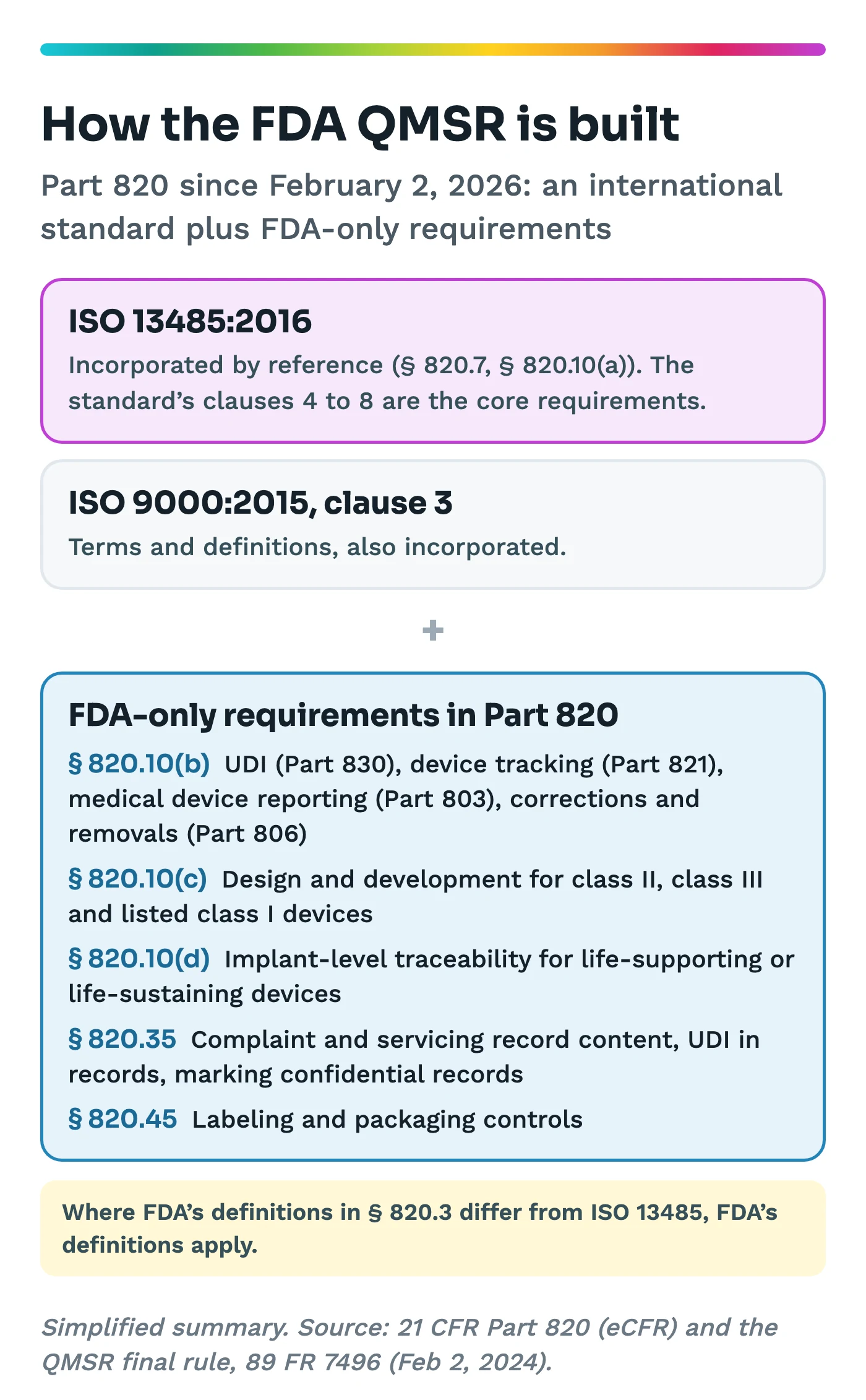
FDA published the final rule “Medical Devices; Quality System Regulation Amendments” on February 2, 2024 (89 FR 7496, Docket No. FDA-2021-N-0507). It rewrote Part 820 and renamed it the Quality Management System Regulation. The old Quality System (QS) regulation spelled out its own requirements in sections 820.20 through 820.250. The new Part 820 instead incorporates two documents by reference in § 820.7: ISO 13485:2016, third edition (March 1, 2016), and Clause 3 (terms and definitions) of ISO 9000:2015.
The regulation itself is short. Subpart A covers scope, definitions, the incorporation by reference and § 820.10, which requires a documented quality management system (QMS) that complies with ISO 13485 and the rest of Part 820. Subpart B adds two supplemental sections: § 820.35 on records and § 820.45 on labeling and packaging. Every other section number is reserved. You can read the whole text in the eCFR version of Part 820.
Three ground rules sit on top of the standard:
The rule took effect on February 2, 2026, two years after publication. Until that date, manufacturers had to keep complying with the QS regulation. On the same day, FDA stopped using the Quality System Inspection Technique (QSIT) and began inspecting under a new compliance program, as its QMSR page explains.
The main changes for a quality team are:
The section-by-section QMSR vs QSR comparison shows where each old requirement landed. Older records do not have to be rewritten. At an April 1, 2026 town hall, FDA said it does not expect manufacturers to revise or recreate records made before February 2, 2026, although investigators may still review them. FDA’s QMSR FAQ suggests a comparative analysis can help show that those records meet QMSR requirements.
Under § 820.1(a), any manufacturer that designs, manufactures, packages, labels, stores, installs or services a finished device intended for human use must have a QMS appropriate for its devices. That covers devices made in any U.S. state or territory, the District of Columbia or Puerto Rico, and devices imported or offered for import. Contract sterilizers, installers, relabelers, remanufacturers, repackers, specification developers and initial distributors of foreign entities that perform these functions are all manufacturers. A firm that performs only some of these operations complies only with the requirements for those operations.
Section 820.10(a) requires you to document a QMS that complies with the applicable requirements of ISO 13485 and the other applicable requirements of Part 820. In practice, the standard is the rulebook, so the quality team needs the text. FDA’s FAQ points to read-only access through the ANSI incorporated-by-reference portal and the ISO Online Browsing Platform. Working copies are sold through the ISO store that § 820.7 names.
Certification is a separate question. FDA does not require or issue ISO 13485 certificates, and a certificate does not exempt a manufacturer from FDA inspection. The Medical Device Single Audit Program (MDSAP) stays voluntary, and FDA uses MDSAP audit reports, not certificates, as an oversight tool: FDA does not run routine surveillance inspections at sites actively enrolled in MDSAP, but those sites can still get for-cause, compliance follow-up and PMA preapproval inspections. If ISO publishes a new edition of ISO 13485, FDA has said it will evaluate the revision and that any change to Part 820 would go through rulemaking. Until then, the 2016 edition is the legal reference.
Section 820.3 applies the ISO 13485 and ISO 9000 definitions, with these exceptions and additions:
| Term | Meaning under the QMSR | Effect |
|---|---|---|
| Device, labeling | Definitions in sections 201(h) and 201(m) of the FD&C Act | Replace the ISO 13485 terms “medical device” and “labelling” |
| Manufacturer, organization | Any person who designs, manufactures, fabricates, assembles or processes a finished device; “organization” means manufacturer | Brings contract sterilizers, relabelers, specification developers and others into scope |
| Implantable medical device | Has the meaning of “implant” in 21 CFR 860.3 | Replaces the ISO 13485 definition |
| Rework | Action on nonconforming product so it meets the requirements in the medical device file before release | Replaces the ISO 9000 definition |
| Safety and performance | Means “safety and effectiveness” | Does not lower the statutory standard |
| Batch or lot, component, finished device, remanufacturer, HCT/P | FDA definitions; a component includes software, firmware and labeling | Added because ISO 13485 does not define them |
Use the tables below as a QMSR checklist for an internal gap check. Each row names the clause, what to verify in your system, and the FDA-specific point or evidence an investigator is likely to ask for. The rows are cross-referenced to the element tables in Attachment A of FDA’s Compliance Program 7382.850. They summarize the standard; they do not replace reading it.
| Clause | What to verify | FDA point or evidence |
|---|---|---|
| 4.1.1–4.1.4 General requirements | Your regulatory roles are documented, QMS processes are defined, and process changes are evaluated before they are made | § 820.10(a) requires the QMS to cover ISO 13485 and the rest of Part 820 |
| 4.1.2(b) Risk-based approach | Controls over QMS processes are proportionate to risk | Investigators review this under Management Oversight |
| 4.1.5 Outsourced processes | Outsourced processes are controlled in proportion to risk, with quality agreements | Reviewed under Outsourcing and Purchasing |
| 4.1.6 QMS software validation | Software used in the QMS (eQMS, ERP, complaint and CAPA tools) is validated before use and after changes | Validation records, with risk-based scope |
| 4.2.2 Quality manual | Scope, justified exclusions and non-application, and the process map are current | A design exclusion is acceptable only for class I devices outside § 820.10(c) |
| 4.2.3 Medical device file | A file exists for each device type or family | Replaces the DMR; § 820.45(c) checks labeling and packaging against it |
| 4.2.4 Control of documents | Review, approval, change control and retention of obsolete documents | Procedures no longer cite old Part 820 section numbers |
| 4.2.5 Control of records | Records are legible, retrievable, protected and kept for the defined period | § 820.35 adds required content for complaint, servicing and UDI records |
| Clause | What to verify | FDA point or evidence |
|---|---|---|
| 5.1–5.4 Commitment, customer focus, policy, objectives, planning | Top management sets the quality policy and measurable objectives and plans QMS changes | FDA expects a culture of quality led by top management |
| 5.5 Responsibility, authority and communication | Roles are defined and a management representative is appointed | Organization charts and appointment records |
| 5.6 Management review | Reviews happen at planned intervals with the required inputs and documented outputs | Review records are now open to investigators |
| 6.1 Provision of resources | Resources match QMS and regulatory needs | Staffing for complaints, CAPA and MDR |
| 6.2 Human resources | Competence is defined, training is given, its effectiveness is checked and records are kept | Training records for the new QMSR terms |
| 6.3 Infrastructure | Buildings, equipment and maintenance are documented | Maintenance records |
| 6.4 Work environment and contamination control | Environmental and contamination controls are documented where they affect the product | Monitoring data for cleanrooms and controlled areas |
Clause 6.2 is the clause people underestimate: it asks you to show that training worked, not only that it happened. The guide to ISO 13485 training requirements covers competence matrices, effectiveness checks and the records investigators expect.
| Clause | What to verify | FDA point or evidence |
|---|---|---|
| 7.1 Planning of product realization | Documented risk management processes in product realization, with records | ISO 14971 is not incorporated, but most firms use it to meet this clause |
| 7.2 Customer-related processes | Requirements are determined and reviewed, and communication includes advisory notices | Advisory notices follow Part 806 (§ 820.10(b)(4)) |
| 7.3.1–7.3.10 Design and development | Planning, inputs, outputs, reviews, verification, validation, transfer, changes and design and development files | Applies to the devices listed in § 820.10(c); the file replaces the DHF |
| 7.4 Purchasing | Supplier evaluation and monitoring are proportionate to risk; purchasing information and verification are documented | Supplier audit reports are now open to investigators |
| 7.5.1 Control of production and service provision | A record for each device or batch shows quantities made and released and traces to the UDI | § 820.45 labeling and packaging controls; § 820.35(c) UDI record |
| 7.5.2–7.5.5 Cleanliness, installation, servicing, sterile devices | Requirements exist where they apply | § 820.35(b) servicing record content |
| 7.5.6–7.5.7 Process and sterilization validation | Processes whose output cannot be fully verified are validated, including production software | Validation protocols, reports and revalidation triggers |
| 7.5.8–7.5.9 Identification and traceability | Identification, traceability and implant records | UDI under Part 830, tracking under Part 821, and implant-level traceability for life-supporting and life-sustaining devices (§ 820.10(d)) |
| 7.5.10–7.5.11 Customer property, preservation of product | Property is protected and product is preserved through delivery | Storage and shelf-life controls |
| 7.6 Monitoring and measuring equipment | Calibration, traceability to standards, and validation of measurement software | Calibration records and out-of-tolerance assessments |
Design and development is where the old design control expectations live, now under Clause 7.3 and its ten subclauses. The guide to design controls for medical devices walks through planning, inputs, verification, validation and the design and development file. The Clause 7.4 row is also covered in an on-demand session on medical device purchasing and supplier controls, which reviews the ISO 13485 supplier requirements.
Design changes run through Clause 7.3.9 and the Change Control area FDA uses during inspections. Section 515C of the FD&C Act lets FDA authorize planned modifications as part of a marketing submission, and FDA’s best-known guidance on it covers AI-enabled device software. Changes made under an authorized predetermined change control plan do not need a new submission, but they still go through your QMS change controls.
| Clause | What to verify | FDA point or evidence |
|---|---|---|
| 8.2.1 Feedback | Production and post-production feedback is gathered and feeds risk management | Trend reports and risk file updates |
| 8.2.2 Complaint handling | Complaints are received, evaluated, investigated or justified, and closed on time | § 820.35(a) record content |
| 8.2.3 Reporting to regulatory authorities | Reportable events are identified and reported | Medical device reports under Part 803; Part 806 reports |
| 8.2.4 Internal audit | Audits are planned, independent, recorded and followed up | Audit reports are now open to investigators |
| 8.2.5–8.2.6 Monitoring and measurement | Process and product monitoring; release records identify who released the product | Acceptance records |
| 8.3 Nonconforming product | Control before and after delivery, including rework | FDA’s rework definition; Part 806 for notices after delivery |
| 8.4 Analysis of data | Data from feedback, suppliers, audits and service are analyzed | Input to management review |
| 8.5 Improvement | Corrective and preventive action with root cause, verification and effectiveness checks | CAPA records linked to complaints, audits and nonconformances |
Corrective action under Clause 8.5.2 starts with finding the real cause. The guide to CAPA root cause analysis covers the 5 Whys, fishbone diagrams and effectiveness checks.
A firm already certified to ISO 13485 still has FDA-specific work. These are the Part 820 requirements that sit on top of the standard:
| Requirement | Part 820 section | ISO 13485 clause it adds to | Who it applies to |
|---|---|---|---|
| UDI system under Part 830 | 820.10(b)(1) | 7.5.8 | Labelers of devices that require a UDI |
| Tracking procedures under Part 821 | 820.10(b)(2) | 7.5.9.1 | Devices under an FDA tracking order |
| Medical device reporting under Part 803 | 820.10(b)(3) | 8.2.3 | All manufacturers |
| Advisory notices under Part 806 (corrections and removals) | 820.10(b)(4) | 7.2.3, 8.2.3, 8.3.3 | All manufacturers |
| Design and development | 820.10(c) | 7.3 | Class II, class III and listed class I devices |
| Implant-level traceability for life-supporting or life-sustaining devices | 820.10(d) | 7.5.9.2 | Those devices |
| Complaint record content | 820.35(a) | 4.2.5, 8.2.2 | All manufacturers |
| Servicing record content | 820.35(b) | 7.5.4 | Firms that service devices |
| UDI recorded for each device or batch | 820.35(c) | 7.5.1, 7.5.8, 7.5.9 | Devices with a UDI |
| Marking confidential records | 820.35(d) | 4.2.5 | Optional |
| Labeling and packaging controls | 820.45 | 7.5.1 | All manufacturers |
Under 21 CFR 820.35, you must keep records of the review, evaluation and investigation of any complaint involving a possible failure of a device, its labeling or packaging to meet specifications. If you skip an investigation because a similar complaint was already investigated, record the justification. For complaints that are MDR-reportable, that you decide to investigate, or that you investigated anyway, the record must include:
Servicing records must show, at a minimum, the device serviced, any UDI or UPC, the date of service, who serviced it, the service performed, and any test and inspection data.
You need documented procedures for the integrity, inspection, storage and operations for labeling and packaging. Where applicable, before release or storage, labeling and packaging must be examined for accuracy, including the UDI or UPC, expiration date, storage instructions, handling instructions and any additional processing instructions. The release of labeling for use must be documented, and labeling operations must prevent mix-ups, with documented inspection results that confirm each device carries the labeling specified in its medical device file.
Yes. The QS regulation let firms withhold management review, internal audit and supplier audit reports from investigators under § 820.180(c). The QMSR drops that exception. In the preamble (response to Comment 55), FDA said those records are kept in the regular course of business and should be readily available, and that other regulators and MDSAP auditing organizations already see them. The FAQ confirms that the exceptions in § 820.180(c) are not maintained.
At the April 2026 town hall, FDA added that management review, internal audit and supplier audit processes are expected to be reviewed in baseline surveillance and PMA preapproval inspections. In other inspection types, they may be reviewed depending on the elements the investigator selects. Write these reports as if an investigator will read them: findings stated plainly, each one tied to a CAPA or a documented decision, and follow-up dates that were met.
Compliance Program 7382.850, Inspection of Medical Device Manufacturers, took effect on February 2, 2026. It replaced QSIT and two older compliance programs (7382.845 and 7383.001). It groups the QMSR into six QMS Areas (Management Oversight; Design and Development; Change Control; Outsourcing and Purchasing; Production and Service Provision; and Measurement, Analysis, and Improvement) and four other applicable FDA requirements: medical device reporting, corrections and removals, tracking, and UDI.
Investigators first learn your products, processes and roles, then use your risk management documentation throughout the inspection to select elements to evaluate. Under Model 1, used for non-baseline surveillance, specific product risk assignment, compliance follow-up, for-cause and PMA postmarket inspections, they cover at least one element in every QMS Area and each of the four other requirements. Model 2, used for baseline surveillance and PMA preapproval inspections, sets minimum elements for each area. The guide to an FDA QMSR inspection covers the models, the inspection types and how to prepare.
Observations still go on Form FDA 483, and FDA said at the town hall that the threshold for compliance action has not changed. Knowing the difference between FDA 483 vs warning letter outcomes, and how to answer each, matters more now that investigators can read your audit and review records.
FDA does not require a formal gap analysis, but a documented comparison is the quickest way to find what your QMS still lacks and to show older records meet the QMSR. A practical sequence:
For a structured walk-through of setting up quality system documentation, training and supplier records and preparing for FDA and ISO audits, the on-demand quality system setup webinar for FDA-regulated products includes a general FDA quality system setup checklist; it is not specific to the QMSR. Design control, risk management, CAPA and supplier sessions are listed under medical device compliance webinars.
The QMSR (Quality Management System Regulation) is FDA’s current good manufacturing practice rule for medical devices in 21 CFR Part 820. It incorporates ISO 13485:2016 by reference and adds FDA-specific requirements for records, labeling and packaging, UDI, complaints and servicing, and ties in medical device reporting, corrections and removals and tracking. It replaced the Quality System (QS) regulation.
FDA published the final rule on February 2, 2024, and it took effect on February 2, 2026. Manufacturers had to follow the old QS regulation until that date. FDA also stopped using the QSIT inspection technique on February 2, 2026.
ISO 13485:2016, the third edition dated March 1, 2016, as listed in 21 CFR 820.7. FDA has said it will evaluate any future revision of the standard, and any change to Part 820 would have to go through rulemaking. Until then, the 2016 edition is the one that applies.
No. FDA does not require or issue ISO 13485 certificates, and a certificate does not exempt a manufacturer from FDA inspection. The Medical Device Single Audit Program (MDSAP) remains voluntary, and FDA uses MDSAP audit reports, not certificates, as an oversight tool.
The QMSR no longer defines or requires those record types. Their content now belongs in the design and development file (Clause 7.3.10), the medical device file (Clause 4.2.3) and the record for each device or batch (Clause 7.5.1). Part 820 does not require you to rename existing files, but each file must meet the ISO 13485 clause it now falls under.
Yes. The QS regulation’s exception in § 820.180(c) for management review, internal audit and supplier audit reports was not carried into the QMSR. FDA expects to review these processes in baseline surveillance and PMA preapproval inspections, and may review them in other inspections.
No rule requires one. FDA’s QMSR FAQ suggests a comparative analysis can help show that records made before February 2, 2026 meet QMSR requirements. A documented comparison is still the practical basis for updating procedures, records and training.
Check your quality system against an expert’s checklist
The on-demand quality system setup webinar for FDA-regulated products covers documentation, training and supplier records and FDA and ISO audit preparation, with a step-by-step checklist. Watch it any time; recordings stay available for six months.
See the quality system webinarThis article is general information, not legal or tax advice. Check the official sources above or consult a qualified advisor for your situation.